

Recovery does not fail because people lack ideas or funding commitments. It fails because the systems underneath, power, water, health, schools, and local economies, are not designed as a connected, governed, financeable whole. That is the operating layer. And in March 2026, three contexts are signalling the same thing: the architecture is what is missing, not the resources.
By Ahmed F. ElFarra, Founder and Principal Architect, PALiNVEST | Former Head of UNIDO Programme Office, Palestine
Programme-specific figures reflect programmatic records. Selected sector indicators reflect World Bank, UNICEF, and WHO reporting.
The Argument This Insight Makes
Across Gaza, Lebanon, and Syria, a common failure pattern is visible. Interventions arrive, energy systems, health supplies, cash transfers, and shelter materials, and recovery still does not hold. Assets are installed. Services do not stabilise. The next response cycle begins from a lower baseline than the one before it.
The reason is consistent: essential services were treated as separate sectors rather than as one connected operating layer. Power fails and water pumping stops. Water stops and health facilities cannot function. Health degrades and the case for returning, investing, and staying weakens. The cascade runs in both directions. When it is held, recovery compounds. When one node fails, the whole layer loses coherence.
The Recovery Service Cascade
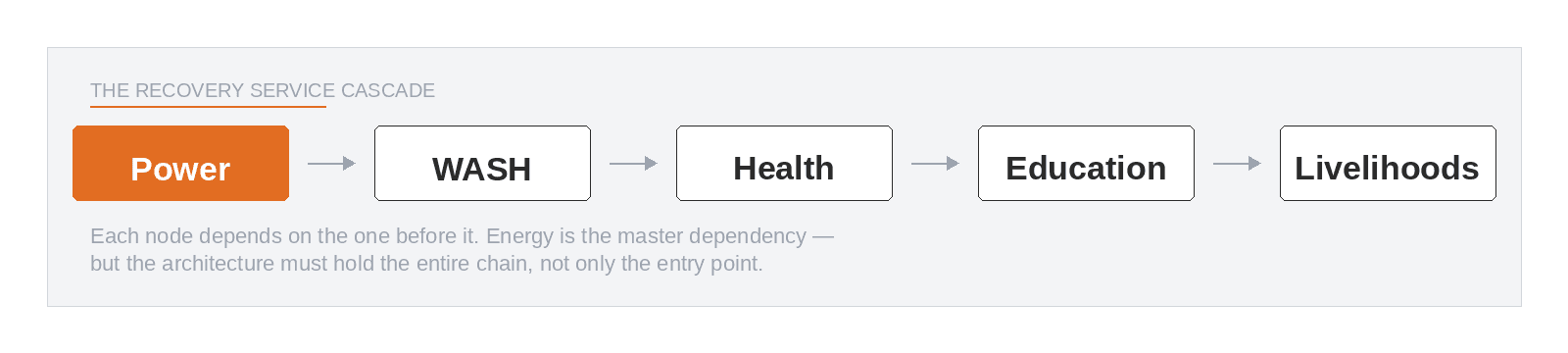
PALiNVEST’s position is not that energy is everything. It is that energy is the operating layer beneath everything else, and that designing it in isolation from services, governance, and livelihoods produces exactly the failure pattern the region keeps repeating.
This is a March 2026 update on what Gaza, Lebanon, and Syria are each signalling, and what the architecture response now needs to hold.
What Gaza Established: A Discipline, Not a Case Study
The MOUSTADAMA Programme, Palestine’s first integrated industrial sustainability and clean-energy transition platform, designed and led through UNIDO with European Union funding, was built for a market where high import energy dependence meant that electricity costs dominated production economics for industrial enterprises, and where grid reliability could not be treated as a planning assumption.
The KHITAN Gaza project made the cascade concrete. In garment and fashion workshops across Gaza, assessed enterprise by enterprise across 43 facilities in the field, blackouts ran for twelve hours a day or more. Generators consumed revenue that workshops needed for wages. Women sewers and pattern cutters restructured working hours around power availability, not production demand. The energy audit was a diagnostic of productive capacity lost daily at every node in the cascade.
The intervention did not lead with equipment. It led with architecture: energy profiling, a co-financing structure built around real SME capacity, and a direct connection to MOUSTADAMA’s technical expertise. In the West Bank, the Hebron Sustainable Energy Eco-Village extended the same logic into industrial cluster design, with clean energy embedded into the foundation of a productive cluster rather than added as an afterthought. Two programmes, different conditions, the same discipline.
That discipline, sequencing, bundling, governance, and proof, is what Gaza established as a methodology. It is what the region is now asking for at larger scale and in harder contexts.
What the Region is Signalling Now
Gaza
The reconstruction need is large by any measure, and the binding constraint is not money committed but absorptive capacity, corridor throughput, and the governance rails that make contracting auditable.
The gap between pledged resources and operational outcomes is sequencing, delivery configuration, and verification.
Gaza is the baseline proof that the operating layer must be designed before it can be financed.
Lebanon
The World Bank describes a modest rebound that remains explicitly fragile and reform contingent. Structural vulnerabilities persist.
The private sector has adapted through generators, hybrid solar, and informal coping, but adaptation is not architecture. What is missing is the bundled, verifiable, maintainable structure that converts coping into a fundable operating layer.
Humanitarian, stabilisation, and development instruments must operate simultaneously. Single-track responses are insufficient.
Syria
UNICEF WASH diagnostics show water production running at around 49 percent of design capacity, driven primarily by power failures, not by WASH system failure. Energy is the master dependency.
WHO reports 57 percent of hospitals and 37 percent of primary health centres are fully operational. The bottleneck is the cascade, not any single sector.
Recovery at scale requires configurable delivery packages that partners can implement and funders can defend, with sequencing and bundling discipline rather than new technology.
Lebanon: Holding Three Things at Once
Lebanon’s situation in 2026 is best understood not as a crisis interrupted by a fragile rebound, but as a protracted fragility environment where the instruments of humanitarian response, stabilisation, and longer-term recovery must operate at the same time, not in sequence.
Poverty has become structural rather than episodic, affecting a large share of the population and driving multi-dimensional deprivation across food, health, and education simultaneously. The south carries additional operational complexity following the 2024 hostilities, with access conditions and return dynamics that require contingency logic built into every programme design.
What Lebanon’s private sector has demonstrated, by building its own distributed energy coping over years of supply failure, is that the demand for the operating layer is real and active. PALiNVEST industrial mapping indicates that Lebanon’s industrial base counted over 4,700 firms across food processing, textiles, chemicals, metals, and plastics in the years before the crisis. It has since contracted, yet remains broadly distributed and actively seeking energy and operational structure that the public system cannot currently provide. These enterprises have not been waiting for a central system to recover. They have been building around its absence.
The architecture gap Lebanon signals is not at the technology level. It is at the level of structured co-financing, operations and maintenance stewardship, spare parts pathways, and verification. That bundle allows distributed coping to become a financeable, scalable operating layer rather than a collection of individual workarounds.
The Services Continuity framework PALiNVEST has developed addresses precisely this gap: tiering what must run first through to what enables productive economic life, and bundling each tier with the governance and verification that allow it to hold. Lebanon is not a market to be created. It is a market in survival mode, waiting for that structure to arrive.
Syria: The Cascade Under Maximum Stress
Syria is where the cascade argument is most visible and most consequential. The UNICEF WASH finding, water production at roughly half of design capacity driven by power failures, is not a water sector problem. It is a cascade problem. Fix the power node and WASH output recovers. Leave it unaddressed and health facilities, schools, and the conditions for return all degrade together.
The technology Syria needs is not complicated or experimental. Distributed generation, modular storage, and hybrid systems are well understood. What is missing is the sequencing discipline that determines deployment order: which nodes must run first, what must be bundled together so continuity holds after installation, and what minimum verification allows funders to scale with confidence in a governance environment that is still being rebuilt.
The World Bank’s re-engagement posture reflects this clearly. Before scaling capital investment, it emphasises public financial management coordination, budget controls, procurement capacity, and integrated financial management systems. The fiduciary rail is not a bureaucratic precondition. It is the architecture that determines whether reconstruction translates into functioning services or into a second generation of stranded assets.
Syria also needs the capacity layer that makes any system operational over time: local engineers, O&M stewards, and enterprise advisors who can maintain what is built. Building that layer is the employment architecture of recovery. These roles are not one-time labour inputs but pathways, the same logic MOUSTADAMA embedded through its capacity-building pillar in Palestine over five years.
Recovery architecture is not designed for stable conditions. It is designed to function precisely when conditions have not yet improved, and to hold the operating layer together while they do.
The MOUSTADAMA Regional CleanTech Investment Event in Cairo was one demonstration of where this logic leads at the pipeline level: Palestinian cleantech entrepreneurs presenting to Egyptian and regional investors within a framework built around recovery and reconstruction demand. Not a showcase, but proof that sequenced, bundled, verified architecture travels across borders when the design is right.
Gaza, Lebanon, Syria. Different contexts, one operating logic. The cascade must be held, power, water, health, education, and livelihoods, as a governed, financed, and verifiable whole. That is the architecture PALiNVEST designs.
If you are working on recovery nodes in any of these contexts and want to talk through what a structured portfolio approach would look like, we are ready to engage.
Designing Resilience. Powering Recovery.
www.palinvest.ps | www.moustadama.ps
From the PALiNVEST Review
Energy for Recovery: The Missing Pillar in MENA’s Clean-Energy Transition →
Energy for Services Continuity: Keeping Essential Systems Running →
Innovating in Fragility: Designing the Future in Uncertain Times →
Rebuilding Futures: Youth and Jobs for Recovery →
About the Author
Ahmed F. ElFarra is the Founder and Principal Architect of PALiNVEST and former Head of the UNIDO Programme Office, Palestine. Over 25 years he has led recovery, industrial, and clean-energy programmes across the MENA Region, including the conception and leadership of the MOUSTADAMA Programme (EU, €6M), KHITAN Gaza (Government of Japan), and the Hebron Sustainable Energy Eco-Village (Italy, €5M). Connect at linkedin.com/in/ahmedelfarra or www.palinvest.ps.